
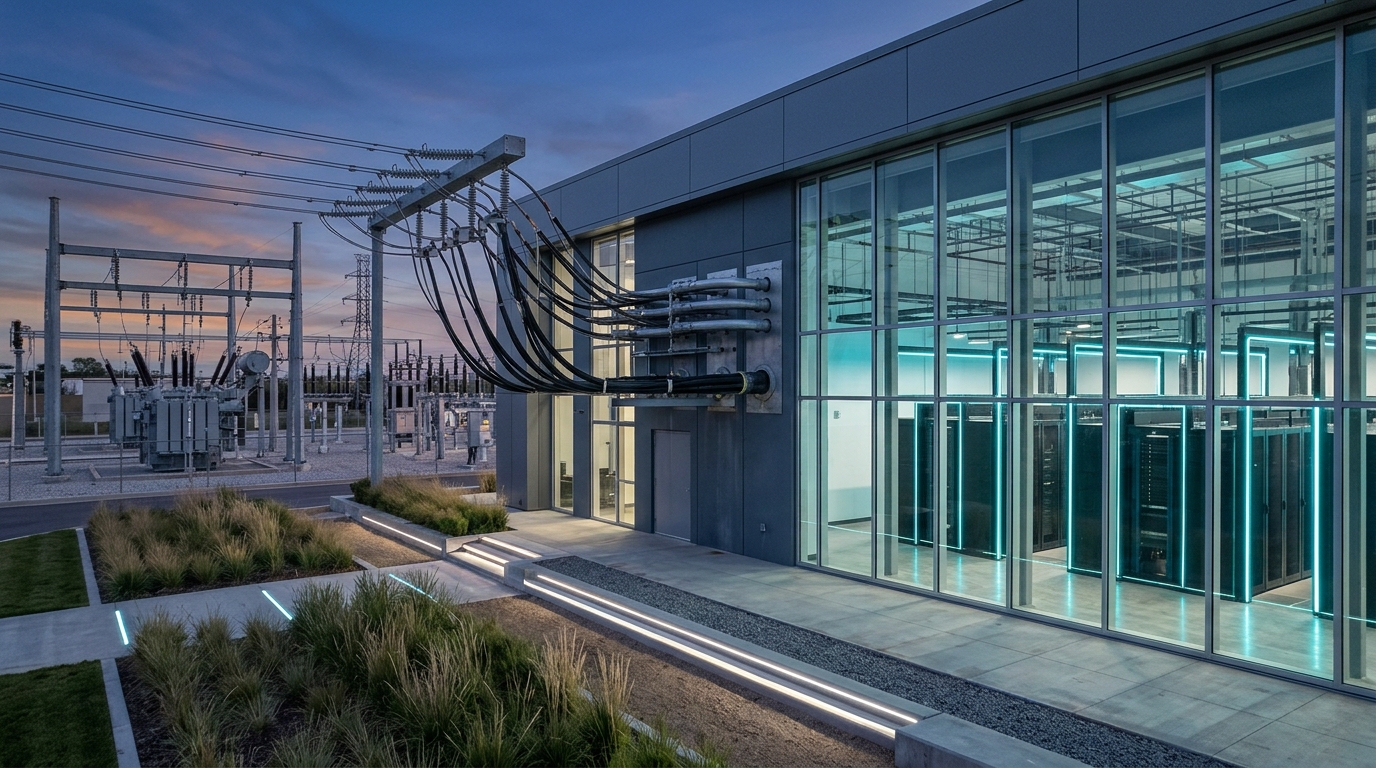
A property listing promises 50 MW of power. The location works, the land is available, and the project appears to check every box for your next AI infrastructure deployment. But before committing capital, there’s a more important question: Can that power actually be delivered when your facility needs it? For neocloud providers and GPU infrastructure operators, data center site selection increasingly comes down to answering that question.
A site may advertise substantial electrical capacity without having the utility infrastructure, approvals, or confirmed delivery schedule needed to bring that capacity online. That distinction can determine whether your investment becomes a revenue-generating AI facility or a costly development project waiting on the grid.
Understanding what to verify before acquiring land, signing agreements, or ordering equipment is essential to protecting your timeline and capital.
What Is the Difference Between Marketed and Deliverable Power?
Not all advertised data center power is created equal.
Marketed power is the electrical capacity promoted as available or potentially available at a property. It may reflect future utility expansion plans, preliminary discussions, or infrastructure that has not yet been approved or constructed.
Deliverable power is electrical capacity supported by a technically feasible, documented utility delivery plan, including required infrastructure upgrades, utility commitments, and a credible energization schedule. It may not be available immediately, but the conditions and dependencies required to deliver it have been identified and evaluated.
The distinction matters because securing a site with a large advertised power allocation does not guarantee that capacity will be ready when your GPU hardware arrives.
According to JLL’s 2026 Global Data Center Outlook, the average wait for a grid connection in primary data center markets now exceeds four years. Speed-to-power has become a leading factor in site selection, making confirmed delivery timelines increasingly important to development decisions.
For organizations planning high-density AI builds, the question isn’t simply how much power a property claims to offer. It’s how much power can be delivered, under what conditions, and by what date.
Why Can a Site Advertise More Power Than It Can Deliver?
A site may sit near a major substation or transmission corridor and still lack the infrastructure required to support a large new electrical load.
Available utility capacity depends on several interconnected factors. A nearby substation may already be serving other customers, require additional transformers, or depend on upstream transmission improvements before it can accommodate a new data center.
The same applies to utility feeders. Even when capacity exists somewhere on the network, delivering it to a specific property may require new circuits, switching equipment, protection upgrades, or additional construction.
A 2026 U.S. Department of Energy-supported technical report on distribution infrastructure highlights the growing mismatch between data center development schedules and utility planning and construction cycles. The research identifies substation and feeder constraints, interconnection requirements, and phased energization as important considerations for large electrical loads.
For neocloud operators investing heavily in GPU infrastructure, those delays can have consequences beyond construction schedules. Hardware procurement, customer commitments, financing milestones, and projected revenue may all depend on when the facility becomes operational. A power delivery delay can quickly become a business problem, not just an engineering challenge.
That’s why proximity to electrical infrastructure should never be confused with confirmed access to power.
What Should You Verify Before Committing to an AI Data Center Site?
Effective site selection due diligence requires looking beyond the property itself. For high-density AI infrastructure, the electrical delivery plan needs to be evaluated alongside the physical, financial, and operational requirements of the project.
Before committing to a site, focus on five critical areas:
- Utility feeder topology: Determine how power will reach the property, whether feeder paths are sufficiently diverse for the intended design, and what upgrades may be required.
- Substation capacity: Verify available capacity, transformer limitations, expansion plans, and whether other committed loads could affect delivery.
- Interconnection timelines: Confirm the utility’s study requirements, construction responsibilities, milestone dates, and conditions that could change the proposed energization schedule.
- Local approvals and permitting: Evaluate zoning, environmental requirements, and the authority having jurisdiction (AHJ), including potential obstacles to electrical infrastructure or facility construction.
- Phased power availability: Establish how much capacity can be delivered initially, when additional phases can be energized, and whether those milestones align with your deployment plan.
These findings should be supported by utility documentation, engineering assessments, and a clearly defined delivery schedule rather than relying solely on marketing materials.
The objective is to identify the risks that could prevent your facility from operating as planned before those risks become expensive commitments.
How Does Power Availability Affect High-Density AI Infrastructure?
For AI infrastructure operators, securing enough total power is only part of the challenge.
A facility supporting 30kW to 100kW or more per rack must also be designed to distribute that power reliably while managing the heat generated by dense GPU deployments. That can require specialized electrical configurations, advanced cooling systems, and infrastructure designed for sustained high-density operation.
A site that can eventually support 20 MW of electrical load may still require substantial engineering before it can accommodate the intended rack densities.
The relationship between utility power, electrical distribution, cooling, and deployment schedules needs to be evaluated early. Otherwise, a project can secure an attractive power commitment only to discover that additional infrastructure is required to make the facility operational.
That is why AI data center site selection should begin with the actual workload requirements, not simply the largest advertised megawatt figure.
Can You Reduce Power Delivery Risk Before Construction Begins?
You can’t eliminate every utility or development dependency, but you can identify many of them before committing significant capital.
One approach is to evaluate whether a site can support phased development. Rather than waiting for an entire planned power allocation to become available, an organization may be able to bring an initial portion of its infrastructure online while additional capacity is developed.
Other opportunities may include evaluating alternative utility arrangements, different site configurations, or supplemental power strategies where technically and commercially appropriate.
Lawrence Berkeley National Laboratory’s June 2026 research on accelerating large-load connections identifies more than 40 potential approaches to addressing grid connection bottlenecks, spanning interconnection processes, resource planning, system operations, and cost allocation.
Not every strategy will work for every location. But evaluating these options early can help determine whether a site’s power limitations are manageable or whether another location offers a more realistic path to deployment.
The important distinction is between a plan that could eventually deliver power and one supported by the engineering, utility coordination, and milestones needed to move forward.
From Site Selection to Execution: Building Around Deliverable Power
Securing the right site is only the beginning. For neocloud providers and AI infrastructure operators, utility coordination, facility design, equipment procurement, and commissioning must all align with the power delivery schedule. Delays at any stage can put capital investments, deployment timelines, and revenue opportunities at risk.
Element Critical helps customers navigate these challenges through its Data Center Strategic Consulting and Data Center Development Services. From evaluating utility feeder topology, substation capacity, and regulatory requirements to coordinating engineering, procurement, construction, and commissioning, our teams help turn site potential into operational infrastructure.
Our approach extends beyond development to ongoing facility operations, helping customers protect their investments and plan for future growth. We start with what your workloads require, not simply what a property promises, so you can make informed decisions, reduce execution risk, and move forward with greater confidence.
Planning a high-density AI build? Explore Element Critical’s Infrastructure Services and connect with our team to evaluate your site and build an infrastructure strategy grounded in deliverable power.
Frequently Asked Questions About AI Data Center Site Selection
What Is Deliverable Power in Data Center Development?
Deliverable power is electrical capacity that can be supplied to a data center under a verified infrastructure and utility delivery plan. Unlike marketed power, which may represent proposed or future capacity, deliverable power is supported by technical assessments, utility coordination, and defined conditions for energization.
How Do You Verify Power Availability at a Data Center Site?
Power availability should be verified through utility engagement, engineering studies, substation and feeder assessments, and documented delivery milestones. Due diligence should identify required upgrades, interconnection conditions, and potential constraints before a developer commits to the property or begins major infrastructure investment.
Why Is Substation Capacity Important for AI Data Centers?
Substation capacity helps determine whether the electrical network can support a facility’s planned load. Existing customer commitments, transformer limitations, and upstream grid constraints may restrict how much power can be delivered. A nearby substation does not automatically guarantee sufficient capacity for a high-density AI deployment.
Can AI Data Centers Be Developed in Phases?
Yes. Phased development can allow organizations to deploy an initial portion of their infrastructure while additional power and facility capacity are prepared. However, each phase must be supported by a feasible utility delivery plan, appropriate electrical and cooling infrastructure, and a schedule that aligns with the intended workloads.