
How much colocation capacity does your business actually need? Commit to too much power, and you could spend months paying for infrastructure you’re not using. Commit to too little, and your next hardware refresh, application launch, or workload expansion could leave you scrambling for additional capacity.
Getting colocation sizing right means looking beyond the number of servers you plan to install. You need to understand their power requirements, how that power will be distributed across cabinets, and how quickly you can get the infrastructure into production.
With colocation options ranging from 10kW to 50kW, organizations can match infrastructure to today’s needs while maintaining a practical path for future growth.
The bottom line? Colocation sizing is the process of determining how much power, rack space, and supporting infrastructure your workloads require. The right deployment balances actual power consumption, rack availability, deployment readiness, and expected growth without forcing your business to commit to capacity it may not need for years.
Why Does Colocation Sizing Matter So Much?
Every kilowatt you commit to should serve a purpose. However, when planning migrations, consolidating server rooms, or preparing for new applications, it’s tempting to reserve more capacity than you need.
Some additional headroom makes sense. The ability to turn up a new device, configure and implement before removing a retiring unit is a necessary process step.
Paying for years of unused capacity because future demand that is uncertain is another story.
Over-provisioning can increase infrastructure costs before that capacity delivers any business value. Under-provisioning creates different challenges, particularly when new equipment pushes a cabinet beyond its available power or cooling capacity. Previous generations of servers typically featured two 600- to 750-watt power supplies. Today, high-performance servers can be configured with four power supplies rated at 3,200 to 3,800 watts each. As a result, a single modern server can have power requirements approaching or exceeding the total power capacity previously allocated to an entire rack.
As Uptime Institute explains in its research on modular and phased data center construction, organizations can expand infrastructure capacity incrementally as demand grows, allowing them to better align infrastructure investments with actual requirements.
For your business, the goal is straightforward: choose enough capacity to support current workloads and anticipated growth without making unnecessary commitments today.
How Much Power Does Your Colocation Deployment Really Need?
Before choosing between 10kW, 20kW, or 50kW, start with the equipment you’re planning to deploy.
One common mistake is treating the maximum rating on every server power supply as the amount of electricity the equipment will continuously consume.
Those numbers aren’t necessarily the same.
A server’s nameplate rating indicates its rated electrical capacity, while actual consumption varies based on hardware configuration, utilization, and workload. Your colocation power requirements should account for realistic operating demand, anticipated workload and seasonal peaks, appropriate electrical headroom, and redundancy needs.
As Schneider Electric explains in its discussion of server power supplies, adding together maximum power supply ratings can significantly overstate actual server consumption.
Rack power density is another important consideration.
According to Uptime Institute’s 2025 Global Data Center Survey, higher-density racks are becoming more common, with growing adoption in the 10kW to 30kW range.
That matters because a deployment requiring 20kW across two cabinets is very different from one requiring 20kW in a single cabinet. The total power may be identical, but the electrical distribution, cooling, and physical configuration can be substantially different.
Understanding both your total data center power requirements and your per-cabinet density helps you choose a footprint that supports your equipment without unnecessary expense.
10kW, 20kW, or 50kW: Which Colocation Option Fits Your Business?
There’s no universal answer. The right capacity depends on your applications, hardware configuration, redundancy requirements, and expected growth.
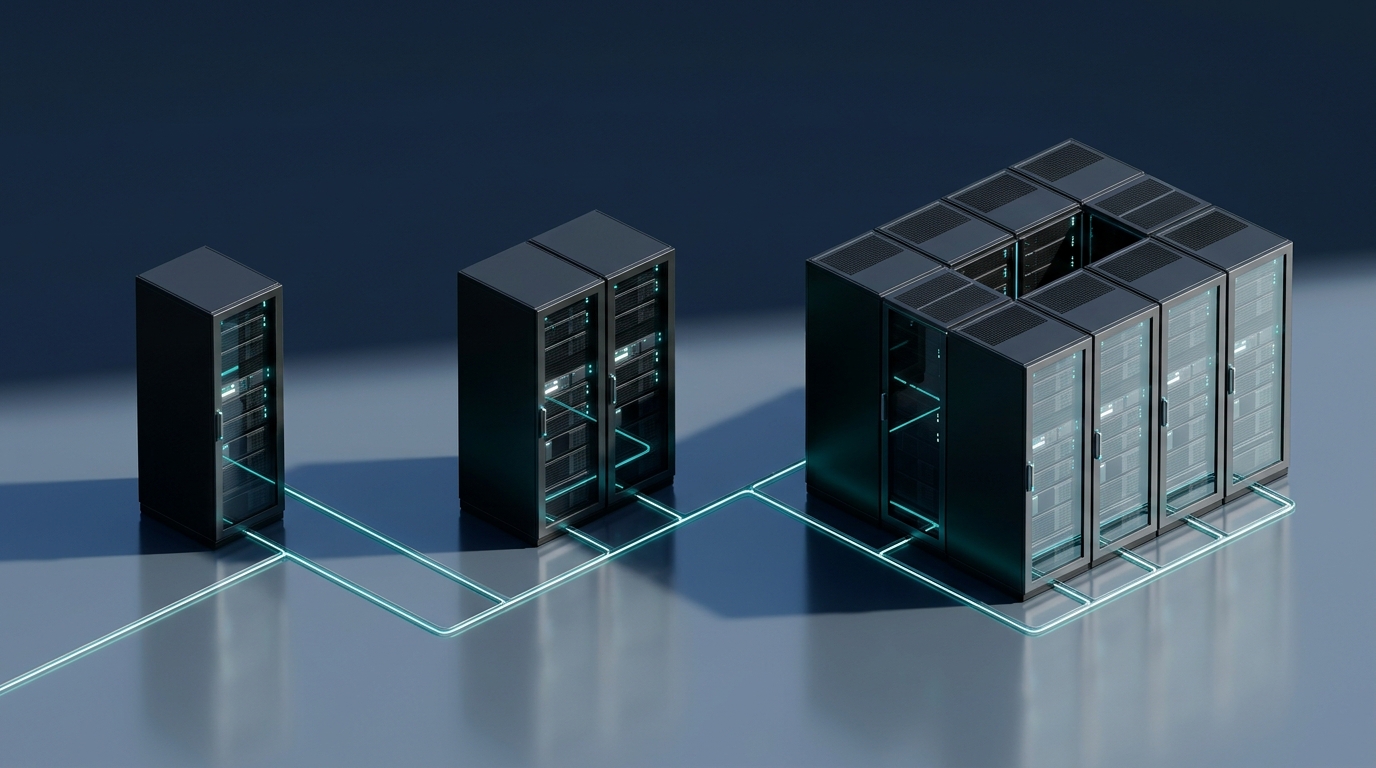
Element Critical’s Grid & Gig offerings provide three starting configurations:
| Capacity | Cabinet Footprint | Potential Applications |
| 10kW | 1 cabinet | Smaller production workloads, disaster recovery, regional infrastructure |
| 20kW | 2 cabinets | Growing applications, server consolidation, hybrid IT |
| 50kW | 5 cabinets | Larger production environments, virtualization, multi-application deployments |
These are examples of how each configuration might be used, not fixed workload limits. Actual suitability depends on equipment power density, cooling, and redundancy requirements.
10kW: Start Small Without Sacrificing Performance
Not every organization needs multiple cabinets or a dedicated data hall to support critical applications.
A 10kW deployment can be a practical starting point for businesses moving production systems out of an on-premises server room, establishing disaster recovery capacity, or expanding into a new geographic market.
Element Critical’s Grid & Gig bundles include a 10kW single-cabinet configuration designed for organizations that need a smaller, defined infrastructure footprint.
The advantage is the ability to establish a colocation presence without committing to significantly more power and space than your initial workload requires.
For organizations with a specific near-term need, that can make it easier to move forward while keeping infrastructure spending aligned with actual demand.
20kW: Give Growing Workloads More Breathing Room
What happens when one cabinet is no longer enough, but a large wholesale deployment still doesn’t make financial sense?
A 20kW option can provide an economical and balanced middle ground.
Element Critical’s 20kW Grid & Gig configuration uses two cabinets, giving organizations more flexibility to distribute workloads, accommodate additional equipment, and support expanding applications.
This may be particularly useful for businesses consolidating smaller server environments, expanding regional operations, or building out hybrid IT infrastructure.
The important consideration is how those workloads will be distributed. Two cabinets provide additional physical space, but the power, cooling, and redundancy configuration still needs to match the equipment.
Rather than committing to a much larger footprint in anticipation of growth, a 20kW deployment lets you address immediate requirements while planning future expansion around actual demand.
250kW: Support Larger Production Environments Without Overcommitting
For organizations operating multiple production applications, larger virtualization environments, or growing regional infrastructure, 50kW may be a more appropriate starting point.
Element Critical’s 50kW Grid & Gig option provides five cabinets, allowing businesses to distribute equipment across a larger footprint while maintaining a defined power commitment.
That can be valuable when several applications require dedicated rack space, infrastructure teams are consolidating equipment from multiple locations, or business growth requires additional computing capacity.
But choosing 50kW doesn’t mean every cabinet needs to be fully utilized on day one.
The objective is to establish a right-sized environment that supports current workloads while providing flexibility as demand increases.
Why Are Infrastructure Projects Delayed When Space Is Available?
Finding available data center space doesn’t necessarily mean your equipment can be deployed.
Power must be ready for the required footprint. Cabinets need the appropriate electrical distribution and cooling. Connectivity must be provisioned, and the environment needs to support your hardware configuration.
If any of those elements are missing, a deployment can remain on hold even when floor space is technically available.
This is why rack availability and deployment readiness should be evaluated together. An empty cabinet is not necessarily a production-ready cabinet.
For organizations facing tight project deadlines, the more useful question is not simply, “Is there space available?” The question becomes: “Can this space support our equipment, power requirements, and connectivity needs when we’re ready to deploy?”
How Can Migration Planning Prevent Deployment Bottlenecks?
Even when capacity is available, poor migration planning can introduce delays between hardware delivery and production.
A successful move requires more than reserving cabinets. Infrastructure teams need to coordinate power, equipment logistics, connectivity, testing, and application cutover before the migration begins.
Four steps can help reduce unnecessary delays:
- Confirm your power and cabinet requirements. Review equipment consumption, rack dimensions, cooling needs, and redundancy requirements before selecting a deployment footprint.
- Verify deployment readiness. Confirm that the required cabinets, power distribution, and connectivity are available within your project timeline. Pre-whipped Ready-to-Go cabinets can reduce the preparation required before installation.
- Coordinate equipment delivery and installation. Establish shipping schedules, site access, installation responsibilities, and any remote hands support needed for rack-and-stack activities.
- Test connectivity and plan the cutover. Validate network paths, application dependencies, and recovery procedures before moving production workloads.
The objective is to identify potential bottlenecks before they affect your go-live date.
A well-planned migration also makes it easier to distinguish between the capacity you need immediately and the infrastructure you can add later.
Connectivity Choices, Network Scalability, Redundancy, and Flexibility
At your current location, commercial telecommunications and carrier services may be limited to just a few providers. Data centers like Element Critical expand those options by bringing connectivity directly to your infrastructure, often just steps away. With access to more than 12 carriers, interconnection providers, and cloud on-ramp services, businesses can establish connections that support their performance, redundancy, and scalability requirements.
From 50 Mbps connections to high-capacity 100 Gbps interconnects, these services can be configured to meet evolving business needs and deployment timelines. Access to multiple providers also enables greater network flexibility and diverse connectivity paths, helping organizations reduce reliance on a single carrier. And because the infrastructure is available just steps from your deployment, businesses can access these services at a fraction of the cost of extending new fiber to a remote office or headquarters.
Can You Right-Size Capacity Without Slowing Down Deployment?
Choosing the right amount of infrastructure shouldn’t mean waiting months to put it into production.
Element Critical addresses both needs through its Ready-to-Go (RTG) cabinets and Grid & Gig colocation options.
With pre-whipped RTG cabinets in Austin, Chicago, and Houston, customers can bypass much of the electrical preparation associated with traditional deployments. Eligible configurations can support turn-up in as little as 24 hours, depending on deployment requirements.
Grid & Gig complements that approach by combining defined power capacity with managed internet services. Instead of forcing customers into larger wholesale commitments, Element Critical offers 10kW, 20kW, and 50kW options designed around different infrastructure requirements.
For organizations that need capacity quickly, this provides an alternative to building new infrastructure or waiting for a custom environment to be prepared.
It’s part of what powering possibility means at Element Critical. We start with what you need, not what we offer, helping you get the right infrastructure into production while maintaining the flexibility to grow as your requirements evolve.
Start With the Capacity You Need, Not What You Might Need Someday
The right colocation deployment isn’t necessarily the largest or the least expensive. It’s the one that supports your applications, fits your budget, and gives your business a practical path forward.
Whether you’re deploying a single cabinet or expanding into a larger production environment, understanding your power requirements, confirming rack availability, and preparing for migration can help you avoid unnecessary spending and keep projects moving.
Ready to find your fit? Build your Grid & Gig bundle today and see how Element Critical can help you right-size your next deployment.
Frequently Asked Questions about Colocation Sizing and Deployment
How quickly can colocation be deployed?
Deployment timelines depend on power availability, cabinet preparation, connectivity, and equipment requirements. Traditional custom deployments can take weeks or months, while pre-provisioned infrastructure can significantly reduce preparation time. Element Critical’s Ready-to-Go cabinets can support turn-up in as little as 24 hours for eligible deployments, depending on the customer’s requirements. Discussions with our knowledgeable, in-house solutions architects greatly prepare clients with answers to these questions.
Why are infrastructure projects delayed?
Infrastructure projects can be delayed by unavailable power, electrical preparation, equipment delivery, connectivity provisioning, and site-specific requirements. Even when data center floor space is available, these dependencies can prevent equipment from entering production. Confirming deployment readiness before committing to capacity helps organizations identify and avoid unnecessary delays.
What are alternatives to building new data center capacity?
Organizations can use existing colocation environments, pre-provisioned cabinets, or modular capacity options instead of building new infrastructure. These approaches can provide access to established power, cooling, connectivity, and operational support. Right-sized colocation also allows businesses to start with their current requirements rather than committing to a larger custom deployment.
How do companies handle deployment bottlenecks?
Companies can reduce deployment bottlenecks by evaluating available power, confirming rack readiness, planning equipment delivery, and validating connectivity before migration. Pre-provisioned colocation environments can eliminate some of the preparation associated with custom deployments. Selecting a provider with available capacity and a clear expansion path can also reduce future infrastructure constraints.