
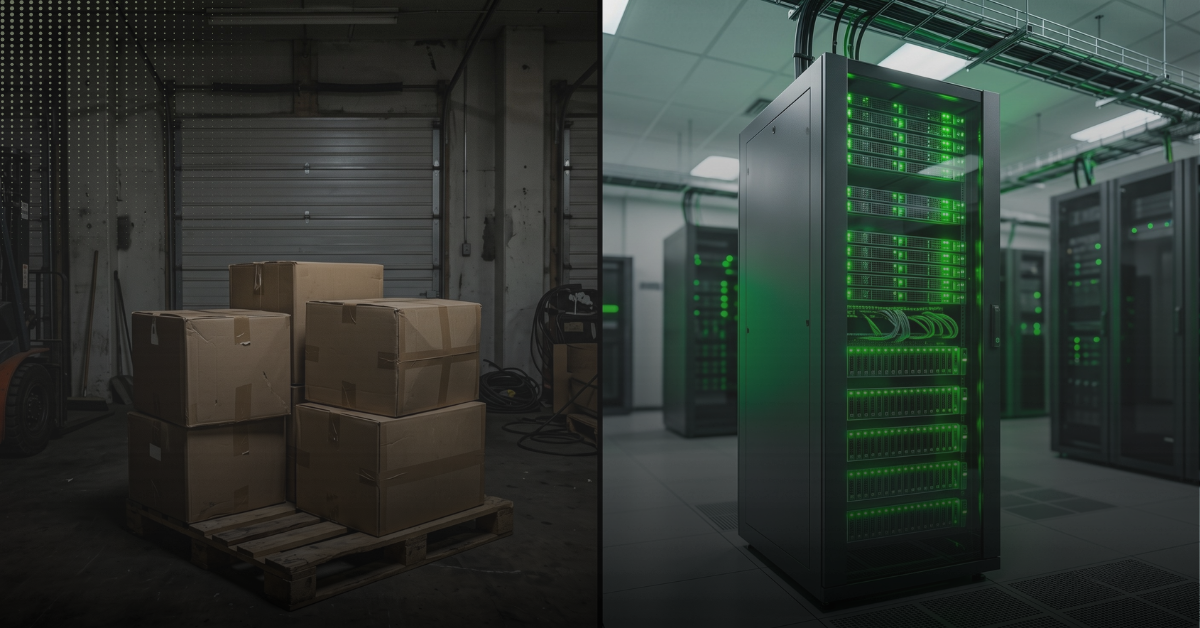
Getting your hardware delivered on time should feel like a major win for your team. But when your servers arrive early, or your data center provider hits a wall on utility power, that hardware sits in a crate, gathering dust and bleeding cash. You don’t have to accept a long delay just to get your racks powered and connected. Below, we break down how agile infrastructure teams bypass traditional deployment queues to get production workloads live in as little as 24 hours.
Direct-Answer Summary
- How quickly can colocation be deployed? Colocation can be fully operational in 24 hours by using Ready-to-Go (RTG) cabinets equipped with pre-run standard power whips.
- Why are infrastructure projects delayed? Most delays stem from long utility lead times, supply chain bottlenecks, and the extensive labor required to configure custom power and network cabling.
- What are alternatives to building new capacity? Instead of waiting on custom build-outs or taking on massive wholesale commitments, companies can deploy immediately into pre-whipped RTG cabinets or pre-packaged 10kW to 50kW capacity bundles.
- How do companies handle deployment bottlenecks? Agile teams bypass bottlenecks by shifting to on-demand, pre-provisioned infrastructure that matches hardware delivery schedules without forcing long-term over-buying.
The High Cost of the Infrastructure Bottleneck
Definition: An infrastructure bottleneck occurs when server, storage, or networking hardware is physically delivered, but cannot be powered or connected due to delays in data center capacity, utility power provisioning, or network turn-up.
When a project stalls, the financial impact extends far beyond simple inconvenience. Every day your hardware sits unpowered on a loading dock is a day of delayed product launches, postponed customer migrations, and idle capital.
Infrastructure bottlenecks usually strike during crucial business triggers:
- Hardware shipments arriving ahead of scheduled site readiness.
- Unplanned workload growth or sudden e-commerce scaling.
- Impending lease expirations at legacy server rooms or colocation sites.
- Urgent disaster recovery (DR) spin-up requirements.
Why Are Infrastructure Projects Delayed in 2026?
The broader colocation market is increasingly oriented toward multi-megawatt AI and hyperscale builds. As a result, small-to-midsize deployments (10kW to 50kW) often get pushed to the back of the line.
When you request a custom deployment, traditional providers typically kick off a lengthy chain of dependencies:
- Utility Coordination: Waiting on utility feeds and power distribution allocation.
- Custom Cabling: Sourcing and manually running power whips and network cross-connects.
- Workstep Scheduling: Managing contractor access and sequential testing.
This legacy process regularly drags a deployment timeline out to 90 days or longer. If your business depends on near-term readiness, that 90-day queue is a liability.
How Companies Handle Deployment Bottlenecks: Traditional vs. Agile
To keep projects on schedule, modern infrastructure managers are abandoning custom-built setups in favor of pre-engineered, standardized capacity. Instead of waiting for custom builds, they rely on pre-provisioned cabinets positioned in key regional markets.
Deployment Strategy Comparison
| Feature | Legacy Custom Build | Element Critical RTG Cabinets |
| Deployment Timeline | 90+ Days | 24 Hours |
| Best Suited For | Multi-Megawatt Wholesale Builds | Local SMBs, Retail, E-Commerce, DR |
| Power Readiness | Custom whip installation required | Pre-run standard whips ready now |
| Footprint Flexibility | Forced wholesale minimums | 1 Cabinet (10kW) up to 5 Cabinets (50kW) |
| Market Availability | Subject to construction queues | Live in Austin, Chicago, and Houston |
How Quickly Can Colocation Be Deployed? The 24-Hour Timeline
Bypassing the long queue requires a fundamentally different deployment architecture. By maintaining a fleet of Ready-to-Go (RTG) cabinets across primary regional hubs (Austin, Chicago, and Houston), you eliminate site preparation work before signing the contract.
Here is how a 24-hour turn-up executes in practice:
- Hour 1: Contract Signed – Documentation is finalized, and cabinet allocation is locked in.
- Hour 12: Access Granted – Facility access credentials are issued; your cabinet is labeled, powered, and ready for install.
- Hour 24: Workloads Live – Hardware is racked, stacked, cabled, drawing power, and passing production traffic.
Stop Waiting: Deploy Today and Protect Your Revenue
You don’t need to over-buy capacity or wait months on utility lead times just to get your servers online. Whether you need a single 10kW cabinet today or want to right-size your footprint using custom scalable 10kW to 50kW capacity bundles, you can start lean and scale on your own terms.
The Q3 Revenue Protection Advantage: Turn up your infrastructure during Q3 on a 12-month term and instantly lower your Year 1 TCO with 3 Months of Free Network or Megaport Port Charges.
Stop letting deployment delays eat your project budget. Claim Your Ready-to-Go Cabinet in Austin, Chicago, or Houston Today.
Frequently Asked Questions
How quickly can colocation be deployed?
Production workloads can be operational in as little as 24 hours when using pre-whipped Ready-to-Go (RTG) cabinets, skipping the standard multi-month site preparation cycle.
Why are infrastructure projects delayed?
Most data center deployment delays stem from long utility power lead times, contractor scheduling queues, and the labor required to manually run custom power whips and cross-connects.
What are alternatives to building new capacity?
Instead of building out new space or signing high-minimum wholesale leases, companies can deploy into pre-provisioned 10kW to 50kW capacity bundles or pre-installed single-cabinet environments.
How do companies handle deployment bottlenecks?
Organizations avoid bottlenecks by selecting data center partners with pre-provisioned, live capacity in strategic regional markets, aligning physical facility readiness directly with hardware delivery schedules.